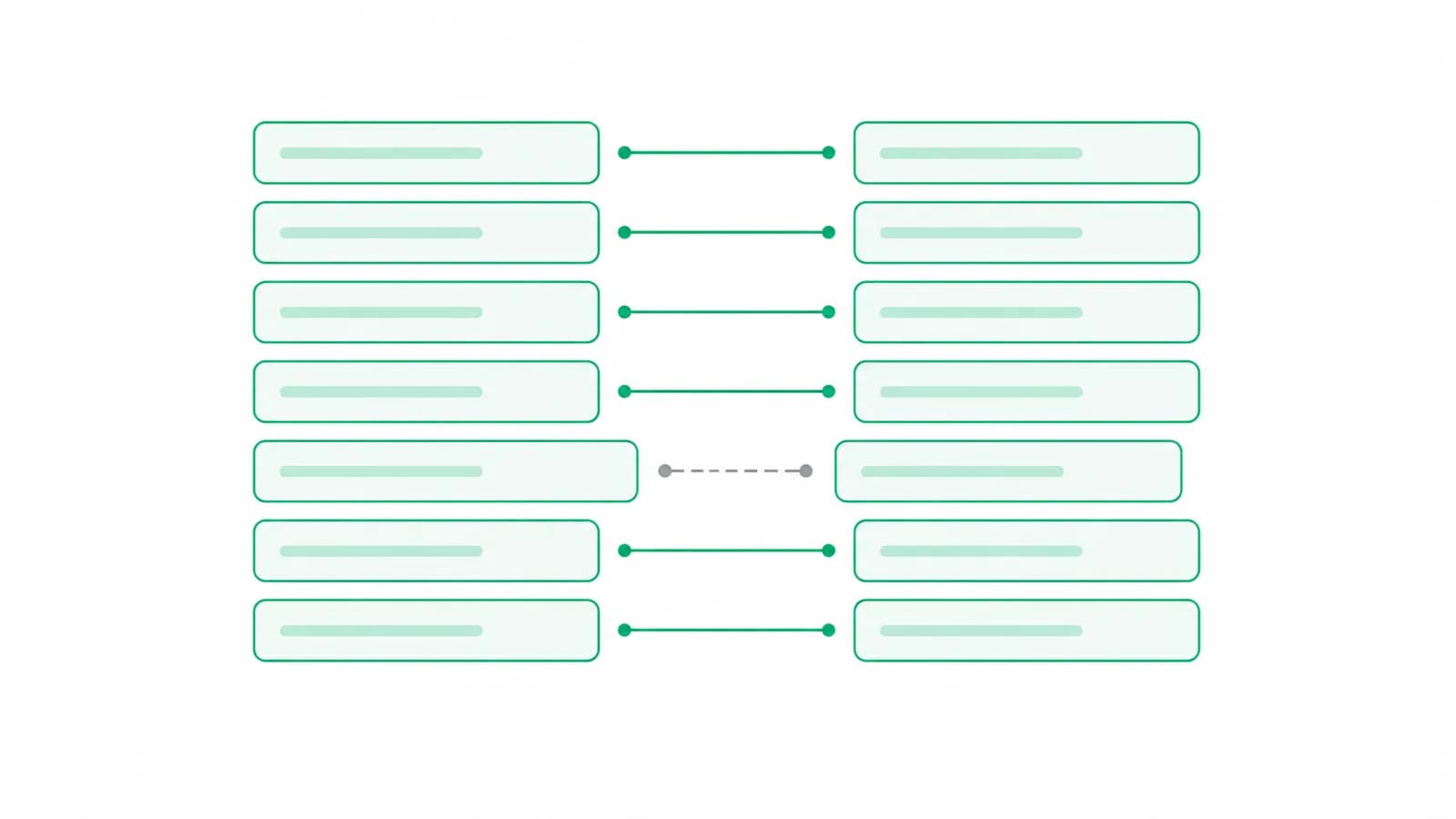

Reconciliation and scrutiny get spoken about as one job, and they are not. Reconciliation asks whether your closing balance agrees with the bank's. Scrutiny asks whether each individual entry is sitting in the right place. A ledger can reconcile to the paisa and still be wrong in every way that matters at audit, because two errors in opposite directions leave the balance untouched.
The bank ledger is where scrutiny starts, for a plain reason: it is the only ledger in the books with an independent external record behind it. Everything else rests on what somebody decided to call a transaction.
Scrutiny is a different question from reconciliation
A bank reconciliation statement explains the gap between two balances at one date, and the differences it surfaces are almost always timing: a cheque issued and not presented, a deposit not yet credited, charges the bank has levied and you have not booked.
Scrutiny asks something else entirely. It asks, of every line: is this the right amount, on the right date, in the right direction, against the right party, under the right head. A reconciled ledger answers none of those.
The practical consequence is that you cannot skip scrutiny because the BRS was clean. They catch different things, and only one of them is what an auditor is testing.
Pro tip
Run scrutiny before reconciliation, not after. Fixing a misposted entry changes the balance, and a reconciliation built on entries you are about to correct has to be done twice.
Start with Suspense, because it is the fastest tell
Open the Suspense ledger for the period and look at the count. If it is not empty, you have found the largest single block of unscrutinised entries in the file, and you have found it in one keystroke.
Suspense fills up for one reason: something was posted before anybody decided what it was. A bulk bank import with no counterparty matching produces exactly this, at scale, which is why imported entries land in Suspense in the first place.
What matters at audit is not that the account was used. It is that it was not emptied. A Suspense balance carried into the financial statements is a statement that the firm did not finish classifying the year.
Important
Suspense with a nil balance is not the same as Suspense with no entries. Equal and opposite postings net to zero and still leave two unclassified transactions in the year. Check the count, not the balance.
The seven checks worth running on a bank ledger
In rough order of how often they turn something up:
- Direction. Every deposit should debit the bank ledger and every withdrawal should credit it, whatever voucher type the entry is filed under. A single reversed entry moves the balance by twice the amount, which makes it easy to spot in the total and surprisingly hard to spot in a row.
- Contra entries appearing twice. Money moved between two accounts the client owns shows on both statements. Import both and you can book the same movement as two separate transactions.
- Round sums. A run of entries at exactly 50,000 or 1,00,000 is not proof of anything, but it is where cash introductions, informal loans and unrecorded drawings tend to sit.
- Blank or transport-only narrations. An entry described as nothing more than the payment rail and a reference number was never classified by a person.
- Personal expenditure in a business account. Ordinary and worth listing, since it becomes drawings rather than expense.
- Entries dated outside the period. Especially at the two edges of the year, where a statement that spans two financial years puts April transactions into March.
- One-sided or oddly grouped postings. A bank entry whose counterpart is another bank ledger, or the cash ledger, is a contra and should be recorded as one.
Reading a ledger for shape, not for lines
Going line by line through eight hundred bank rows is how scrutiny gets abandoned halfway. It is also unnecessary, because the errors that matter change the shape of the data before they change any single row.
A party-wise view is the quickest way to see that shape. The same statement rearranged around who the money moved between, rather than the order it happened in, surfaces things a date-ordered ledger hides: a supplier appearing under four spellings, a party with fifty debits and no credits, a counterparty you do not recognise carrying a material total.
Group the year by counterparty first, deal with anything that looks wrong at that level, and only then go into individual entries. Most files need line-level attention on perhaps twenty rows.
Pro tip
A counterparty with a large net position and a small transaction count is worth opening first. Big and rare is where misclassification hides; small and frequent is usually charges.
Check both edges of the period
The two riskiest dates in any bank ledger are the first and the last.
At the opening edge, confirm the ledger's opening balance agrees with the statement's, and remember Tally's inverted convention for that field: in the XML a negative opening balance is a debit balance. Getting it backwards flips a bank account into an overdraft. If the figure is out, an opening balance mismatch is usually a single missing or duplicated entry rather than a drift.
At the closing edge, look for cheques issued in the last fortnight of March. They belong to the year in which they were issued, not the year in which they cleared, and a statement downloaded after year end tempts you to treat them as next year's problem.
Conclusion
Scrutiny is not a heroic exercise. It is Suspense, direction, contras, round sums, narrations, and the two edges of the period, run in that order. Nearly everything that fails an audit is in that list.
What makes it slow is not the checking, it is that the ledger arrives unclassified: entries with no party attached, sitting in Suspense, waiting for somebody to decide what they were. Greenote reads the counterparty out of the narration and binds it to a ledger that already exists in your Tally company before anything is posted, and it produces the party-wise view described above as a report. See what the party ledger contains.
Turn bank statements into Tally vouchers offline
Greenote reads 100+ Indian banks and posts clean vouchers straight into Tally, fully on your PC. No uploads, no cloud, no manual entry.
7-day free trial, no card required. Works with Tally Prime & ERP 9.