A client spends abroad, or pays a supplier in dollars, and the statement line stops being one line. There is an amount in the foreign currency, the name or code of that currency, a rupee amount, and usually a separate charge somewhere nearby.
Only one of those figures goes into the books as the transaction. The others are not decoration, though, and discarding them costs you the ability to answer the question the client will actually ask.
This is also the single most layout-sensitive thing on a statement, which is why imports go wrong here more than anywhere else.
Which figure is the entry
The rupee figure the bank or issuer actually debited. That is the transaction, because that is the amount of money that left the account.
It already includes the rate the bank applied, which is not the published mid-market rate and is not yours to recalculate. Working the rupee figure out yourself from the foreign amount and a rate you looked up will produce a number that does not match the statement, and the difference will sit in the reconciliation forever.
The foreign amount and the currency are information attached to that entry. They belong in the narration, and they are what lets somebody later answer "what was this in dollars" without going back to the statement.
The markup, conversion charge or cross-currency fee is usually a separate line, and it is a separate entry: a bank charge, with GST on it, which is the most reliably mis-booked thing on an Indian statement.
Pro tip
Put the foreign amount and the currency in the narration of the rupee entry rather than in a separate field nobody will look at. The question it answers is always asked months later, by somebody reading the ledger.
Why the layout breaks readers
Here is the part worth understanding if you ever have to judge whether an import can be trusted.
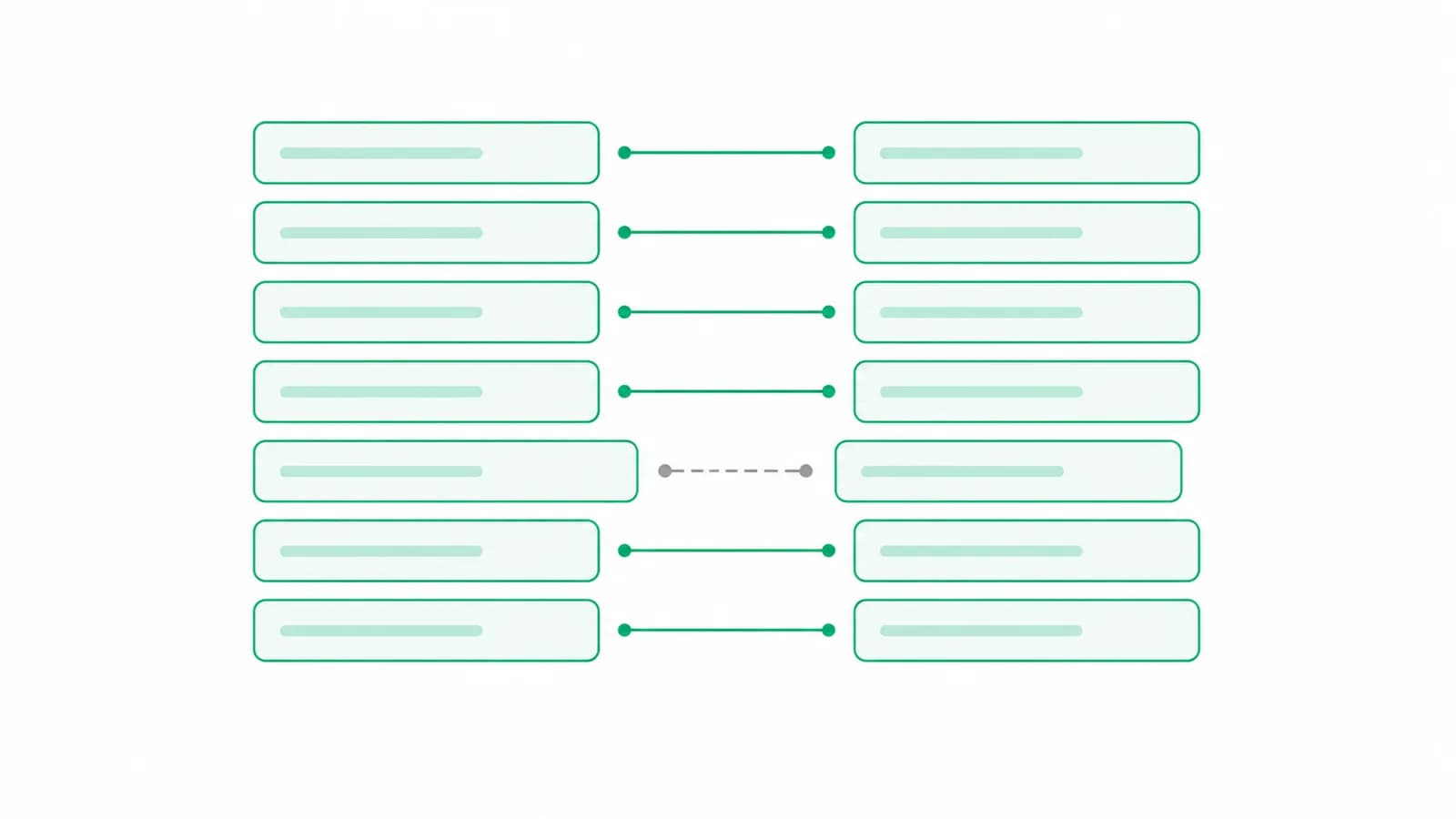
On a statement that prints foreign spends properly, the foreign amount sits in its own column, and the name of the currency is printed on the row underneath it, ending at the same right edge. So a single transaction occupies two rows, and the second row has no date, no narration and no rupee amount. It is a continuation.
A reader that treats each row as a transaction produces a phantom entry with no amount, or drops the currency entirely. A reader that joins rows by looking only at the leftmost column misses it too, because the join is on the right edge.
Refunds are worse. A refund of a foreign spend can print the currency name and the credit marker underneath the line, either both on one row at their own separate edges, or with the credit marker on a row of its own below the currency name. That is one transaction across three rows, and the thing that marks it as a credit rather than a charge is on the third.
Get that wrong and a refund posts as a charge, which is a difference of twice the amount in the ledger.
Important
A refund of a foreign spend read as a charge is wrong by double the value, and it will still reconcile against the closing balance if other rows absorbed the error. Check foreign refunds by hand.
Two small things that bite
Grouping. Foreign currency figures on these statements routinely use Western grouping, 123,456.78, where the rupee column on the same page uses Indian grouping. A reader built for one and applied to the other will misread by a factor of a hundred on larger amounts, and the misreading looks like an ordinary number.
Honest coverage. Some of these layouts are rare enough that nobody has seen a real example of every variation. A refund of a foreign spend is uncommon on any given statement, so a reader may have been proved against a constructed example rather than a real one.
That is acceptable, and the way to keep it acceptable is the same as everywhere else in this work: the totals printed on the statement still have to agree with what was read. A constructed test proves the shape. The statement's own totals prove the reading.
Where this leaves the entry
In the books, a foreign spend from a bank account is an ordinary payment at the rupee figure, with the foreign amount and currency carried in the narration, plus a separate entry for the conversion charge and its GST.
On a card it follows the card rule rather than the bank rule: a foreign charge credits the card like any other charge, because a card is a liability rather than a bank account. The fact that the spend was abroad changes the narration, not the direction.
Where a genuine exchange difference arises, between booking a liability at one rate and settling it at another, that is a separate matter and it belongs in its own head rather than being buried in the expense. The statement cannot tell you about it, because the statement only ever knows what it charged.
Conclusion
One figure posts: the rupee amount that actually moved. The foreign amount and its currency are narration, the conversion charge is its own entry with its own GST, and an exchange difference is a different question entirely.
The risk is in the layout rather than the accounting. A transaction that occupies three rows, with the thing that marks it a credit on the last of them, is where imports quietly invert.
Turn bank statements into Tally vouchers on your own PC
Greenote reads 100+ Indian banks and posts clean vouchers straight into Tally, from your own PC. The statement is not uploaded, and nothing is typed by hand.
Free trial: 7 days or 5 statements, no card. Works with Tally Prime & ERP 9.