
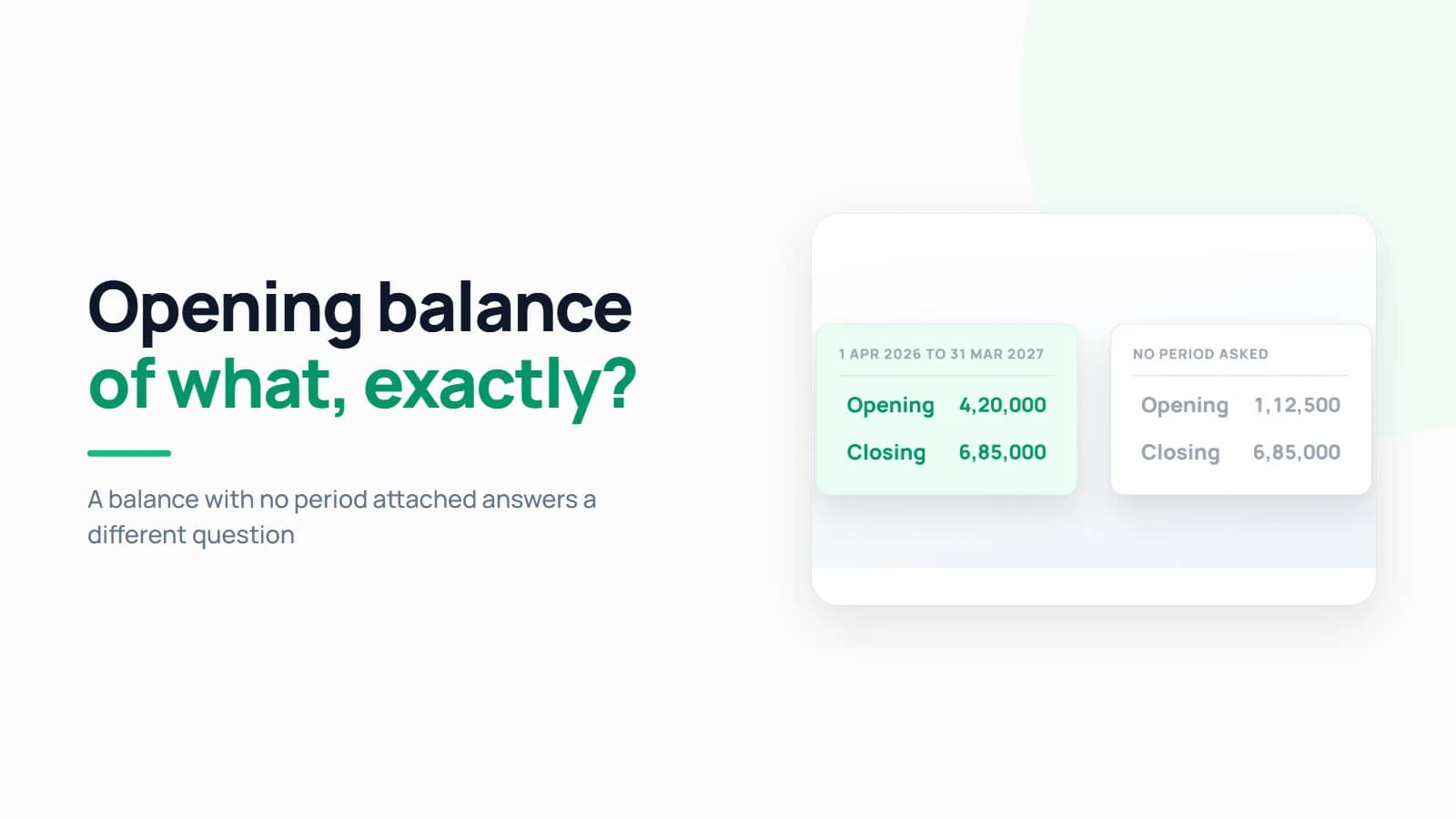
"What is the opening balance of this ledger" sounds like a question with one answer. It has at least two, and they differ by however much happened in between.
An opening balance is only meaningful against a stated period. Opening of what? Of April? Of the year? Of the whole history of the account? Each is a real figure and they are rarely the same.
When a figure arrives without the period it belongs to, it is not wrong. It is unlabelled, which is worse, because it looks like the thing you were expecting.
What a period does to the answer
Measured on TallyPrime 7.1, asking for a balance sheet ledger with a stated period behaves exactly as you would hope:
- the opening is the ledger's balance at the first day of that period;
- the closing is its balance at the last day.
Ask without stating a period and something different comes out: the balance carried forward, which is the account's position as it stands rather than the opening of any period you had in mind.
On a client whose books run from an earlier year, that carried-forward figure can be years of movement away from the April opening somebody was actually asking about. Both are correct. Only one is the answer.
The rule to hold: an opening balance without a period attached is not a fact about a period, and should not be entered as one.
Important
This is the quiet version of the problem. The figure looks plausible, it is internally consistent, and nothing flags it. It is simply the answer to a different question.
Profit and loss ledgers do not behave like this at all
There is a second distinction underneath the first, and it catches people who have got the period right.
A balance sheet ledger carries its balance forward. A bank account, a creditor, a loan: each period starts where the last one ended, which is why an opening and a closing both mean something.
A profit and loss ledger restarts every period. Sales, rent, bank charges: ask for a period and what comes back is what happened in that period, not a position at its edges.
So the same request, against two ledgers, returns two different kinds of number. One is a position, one is a movement, and the answer does not announce which it is.
The consequence is the rule that saves the most grief: never add balances across months. Twelve monthly figures from a P&L ledger add up to the year, because they are movements. Twelve from a balance sheet ledger add up to nothing at all, because you have added a position to itself twelve times. Any figure carried between months should travel with a label saying which kind it is.
Pro tip
When a monthly comparison looks roughly twelve times too big, this is nearly always why. Check whether the ledger you summed is a balance sheet one before looking anywhere else.
Where this shows up in real work
An opening balance that will not tie. The first thing to check is not the entries; it is whether the figure in hand is the opening of the period being reconciled or a carried-forward figure that arrived unlabelled. Finding an opening balance break assumes the figure is the right kind to begin with.
A statement that crosses a year end. The opening of the second year is the closing of the first, and only if the first was complete when it was taken. Importing March late changes an opening that was already recorded. Statements across two financial years is the same trap from the document side.
A comparison between two periods. Comparing a balance sheet ledger's closing figures tells you the change. Comparing a P&L ledger's figures tells you the two movements. Mixing the two in one table is a report that cannot be read.
The habit that prevents all of it
Carry the period with the figure, always. Not in a heading somewhere above it, but attached to the number itself, so that it cannot be copied into a working paper on its own.
And carry what kind of figure it is. A number that knows it is a movement cannot be added to a position by accident, and the person reading it six weeks later does not have to remember which ledgers were which.
Greenote does this for exactly this reason: every figure it brings out of Tally carries whether it is a balance or a movement for the period asked, because the reply itself does not say, and a figure that has lost that distinction cannot have it worked out again later.
Conclusion
Opening and closing are only meaningful against a period. Without one, what arrives is the carried-forward position, which is right and is not what was asked.
Underneath that, a balance sheet ledger gives a position and a profit and loss ledger gives a movement, and nothing in the answer distinguishes them. That is why monthly balances must never be summed.
See what Greenote reads from Tally, or how an import goes wrong quietly.
Turn bank statements into Tally vouchers on your own PC
Greenote reads 100+ Indian banks and posts clean vouchers straight into Tally, from your own PC. The statement is not uploaded, and nothing is typed by hand.
Free trial: 7 days or 5 statements, no card. Works with Tally Prime & ERP 9.