
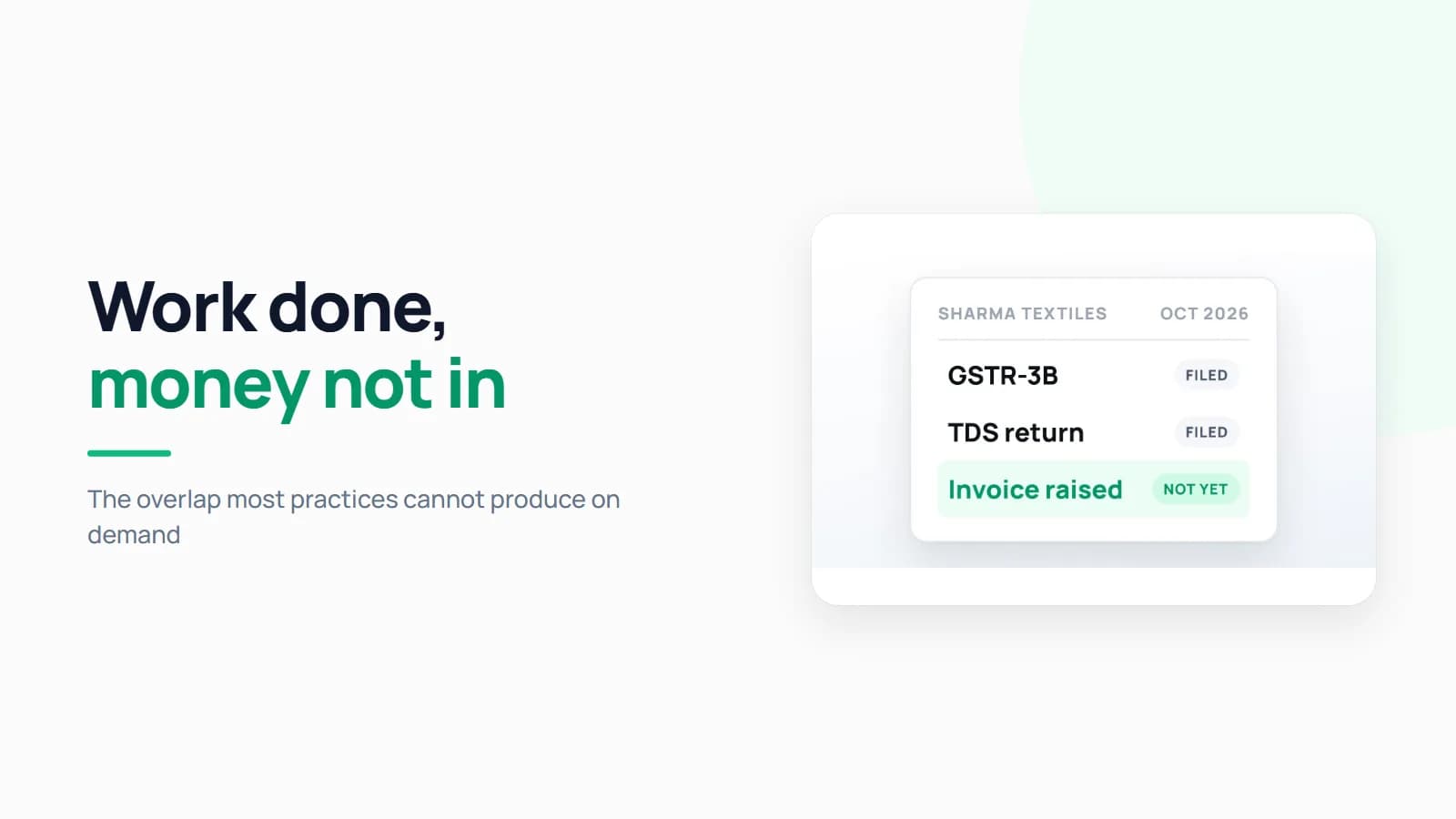
A practice knows what it owes its clients before the year starts. The returns, the statements, the audits: the statutory calendar lays them out, client by client, with dates attached.
What it does not lay out is whether anybody was paid for them.
The interesting number in a practice is not revenue and it is not outstanding. It is work done where the money is not in, and most firms cannot produce it on demand, because the record of the work and the record of the money were never connected.
The view that matters
Three populations, and the overlap between the first two is where the money is.
Work the calendar created. Known in advance, per client. It does not need anybody to enter it.
Work actually done. A fact, derivable from what was produced: the return that exists, the reconciliation that ran.
Money billed and received. The invoice, and whether it was paid.
Most software gives you the third and asks you to type the first two. The useful arrangement is the reverse: the calendar supplies the first, the work itself supplies the second, and a person only has to decide about money.
Run that way, "work done, money not in" is a report rather than an exercise. Run the other way, it is an afternoon with a spreadsheet, which is why it happens twice a year rather than monthly.
A fee must not restate whether the work is done
This is the same rule that governs a task list, and it is broken in the same way.
It is tempting to let a fee record carry a flag saying the work it relates to is complete. It makes the billing view self-contained and it removes a lookup.
It also creates a second answer to a question that already has one. The work either happened or it did not, and that is knowable from what was produced. A flag on a fee record is a person's recollection of that, entered at a different time, and when the two disagree the fee record is the one that gets believed, because it is the one the person raising the invoice is looking at.
The discipline is that a fee record holds money facts only: what was agreed, what was invoiced, what came in, what is outstanding. Whether the work is done is read from the work. The same boundary applies to allocating work, for the same reason.
Important
A fee marked against completed work that was never completed is how a client gets billed for something they then have to be refunded for. The embarrassment is bigger than the amount.
Three decisions that are not the software to make
The invoice number is the office's. Firms number invoices in a way that fits their own records, and often their own history. Software that generates its own series creates a second numbering, and then a reconciliation between two numberings. Take the number; do not invent it.
The tax rate comes from the year's own table. A rate typed into a template is a rate that will still be there after it changes. It should be read per financial year from a recorded source, not written into the billing.
Who may see fees is a wall, not a label. This one is worth being blunt about. In a practice, fee information is not something everybody should see, and the common implementation is to hide the column while the underlying request still returns the figures. Anybody who looks slightly harder sees everything.
The correct version is that a person without permission gets nothing: not a hidden figure, not a greyed-out box, nothing. The difference is invisible until it matters, and then it is the only thing that matters.
Pro tip
Ask your software whether a person without fee permission can see fee figures by any route at all. The honest answer is sometimes no and sometimes "the page hides them", and those are very different products.
Making the recovery conversation easier
Most fee recovery is lost to vagueness rather than to refusal. A client asked for money is being asked about something that happened months ago, often by somebody who did not do it.
Three things make that conversation shorter.
Bill close to the work. A return filed in October billed in October is a conversation about this month. Billed in March it is an archaeology project.
Say what the fee is for in the client's terms. Not "professional services" but the return, the period, the client's own entity. The calendar already has those words; use them.
Know what else is outstanding before raising the next one. A firm that bills a fourth invoice without mentioning three unpaid ones has taught the client that the invoices are not serious.
None of that is a software feature exactly. It is what becomes possible when the work and the money are in the same place, keyed to the same client, with the dates intact.
Conclusion
The calendar knows what was due. The work knows what was done. The only thing a person has to decide is the money, and that is the part most systems make easy while leaving the other two to memory.
Keep the fee record to money facts, take the invoice number from the office, read the rate from the year, and make the permission real rather than cosmetic.
See what the practice workspace covers, or what else a firm should keep in one place.
Turn bank statements into Tally vouchers on your own PC
Greenote reads 100+ Indian banks and posts clean vouchers straight into Tally, from your own PC. The statement is not uploaded, and nothing is typed by hand.
Free trial: 7 days or 5 statements, no card. Works with Tally Prime & ERP 9.