
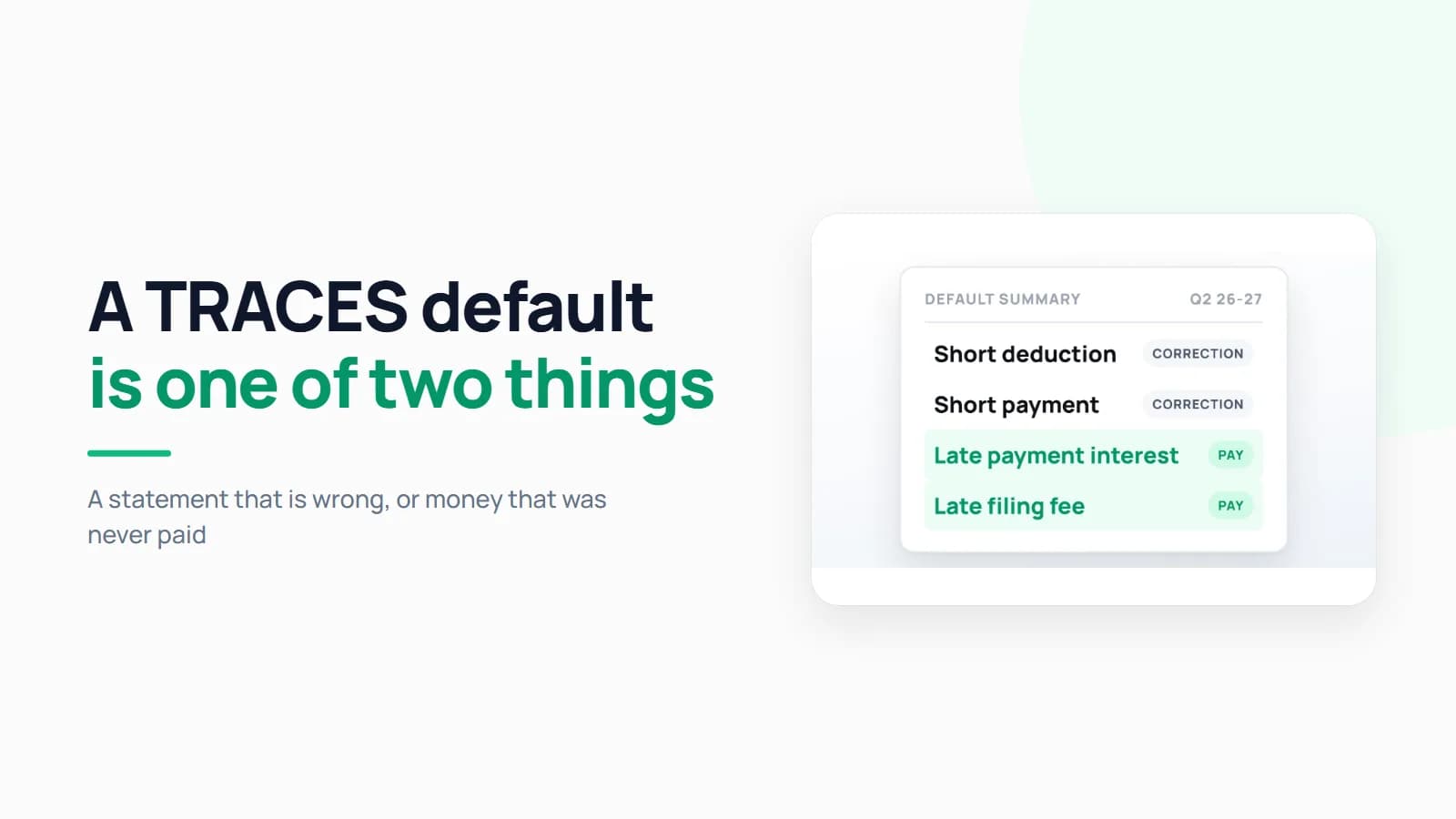
A statement is filed, it gets processed, and a while later TRACES lists defaults against it. There is a summary, and behind it a justification report, and between them they produce a number the client wants explained.
The instinct is to open a correction. For about half of these, a correction cannot fix the problem no matter how carefully it is prepared, because nothing about the statement is wrong.
So the first question is not what to correct. It is which of two kinds of default this is.
The six, and the line that runs through them
TRACES raises defaults of six kinds.
| Default | What it says |
|---|---|
| Short deduction | Less tax was deducted than the statement implies was due |
| Short payment | Less was paid than the statement says was deducted |
| Interest on late deduction | Tax deducted after the date it became deductible |
| Interest on late payment | Tax paid after the date it became payable |
| Interest on short payment | Interest on the shortfall itself |
| Late filing fee | The statement went in after its due date |
And they divide cleanly in two.
Some are a statement that is wrong. The underlying facts are fine; what was filed does not describe them. A correction fixes that.
The rest are money that has not been paid. The statement is a true account of events, and the events include a shortfall. No correction will remove it, because there is nothing in the statement to correct. The fix is to pay, and then to attach that payment to the statement.
Most wasted effort in this corner comes from treating the second group like the first.
Which causes a correction can actually fix
Within the first group, the cause decides what a correction has to change, and the list is short.
A short deduction is usually one of four things: the wrong PAN against the deductee, the wrong section code, the wrong rate, or the wrong amount. A certificate authorising a lower rate also lands here when the line was filed without its flag and number, which is covered in what a lower deduction certificate has to carry.
A short payment is either a wrong amount in the statement, or a challan that exists but is not attached to the right lines.
Every interest default and the late filing fee are correctable only in the challan sense: the money has to be paid and the challan brought into the statement.
That last row is worth sitting with. If interest has been computed because tax really was deposited late, no edit to the statement makes it go away. The statement is right.
Pro tip
Before preparing anything, write the cause beside each default in one line. Half of them will turn out to need a payment, and knowing that first changes what you tell the client about cost.
Why you cannot just add the challan in a correction file
Here is the procedural trap, and it catches people who know corrections well.
The obvious move for an unpaid default is to pay it and add the new challan to the statement through a correction file. That batch exists in the published formats, and a tool reading those formats will offer it.
It is discontinued for every deductor except a government one. Adding a challan by correction file is not accepted. The route is the online correction facility, where the challan is added to the statement directly.
So the fix for the money-not-paid group has three steps and only the first is familiar: pay the amount, then add the challan on the portal, then tag it to the lines it covers. None of it happens in the file you would normally prepare. What a correction file can and cannot change covers the other half.
Important
A tool that offers to add a challan through a correction file is reading the published format rather than what is accepted. The format defining a batch is not the same as the department taking one.
A note on the justification report
The justification report is where the detail lives, line by line, and it is also the least machine-friendly document in this process.
It is supplied as a text file intended for a particular utility, and no layout for it is published. That means anything claiming to read it automatically is working from a guess about its columns.
For a figure that is going to be quoted to a client and possibly paid, a guessed column is not a good foundation. The defensible approach is for a person to read the report and record what each default says, with the tool taking those figures rather than inventing them.
Greenote works this way deliberately: the defaults are what the CA reads off the report, and the software then says which fix each one takes and gathers every correctable one into a single set of changes rather than several separate corrections.
What to do with the answer
Once each default is sorted into the two groups, the work becomes ordinary.
Gather every correctable default into one correction, not one per default. A quarter with four PAN errors and a wrong section is a single correction, and sending five is five chances for the previous token to be wrong.
Deal with the payments together, because interest keeps running until they are made, and a client who is going to be asked for money twice would rather be asked once.
Then check the cause did not survive. A short deduction from a wrong rate means the rate is probably still wrong in whatever produced the statement, and the next quarter is already being prepared the same way.
That last one is the difference between clearing a default and not getting it again.
Conclusion
Six kinds, two groups, one question: is the statement wrong, or is the money short?
A wrong statement is a correction. A shortfall is a payment followed by an online correction to attach the challan, because adding one through a correction file is not available to an ordinary deductor.
Finding deductions nobody made is how to stop meeting these, and the TDS workspace is here.
Turn bank statements into Tally vouchers on your own PC
Greenote reads 100+ Indian banks and posts clean vouchers straight into Tally, from your own PC. The statement is not uploaded, and nothing is typed by hand.
Free trial: 7 days or 5 statements, no card. Works with Tally Prime & ERP 9.