
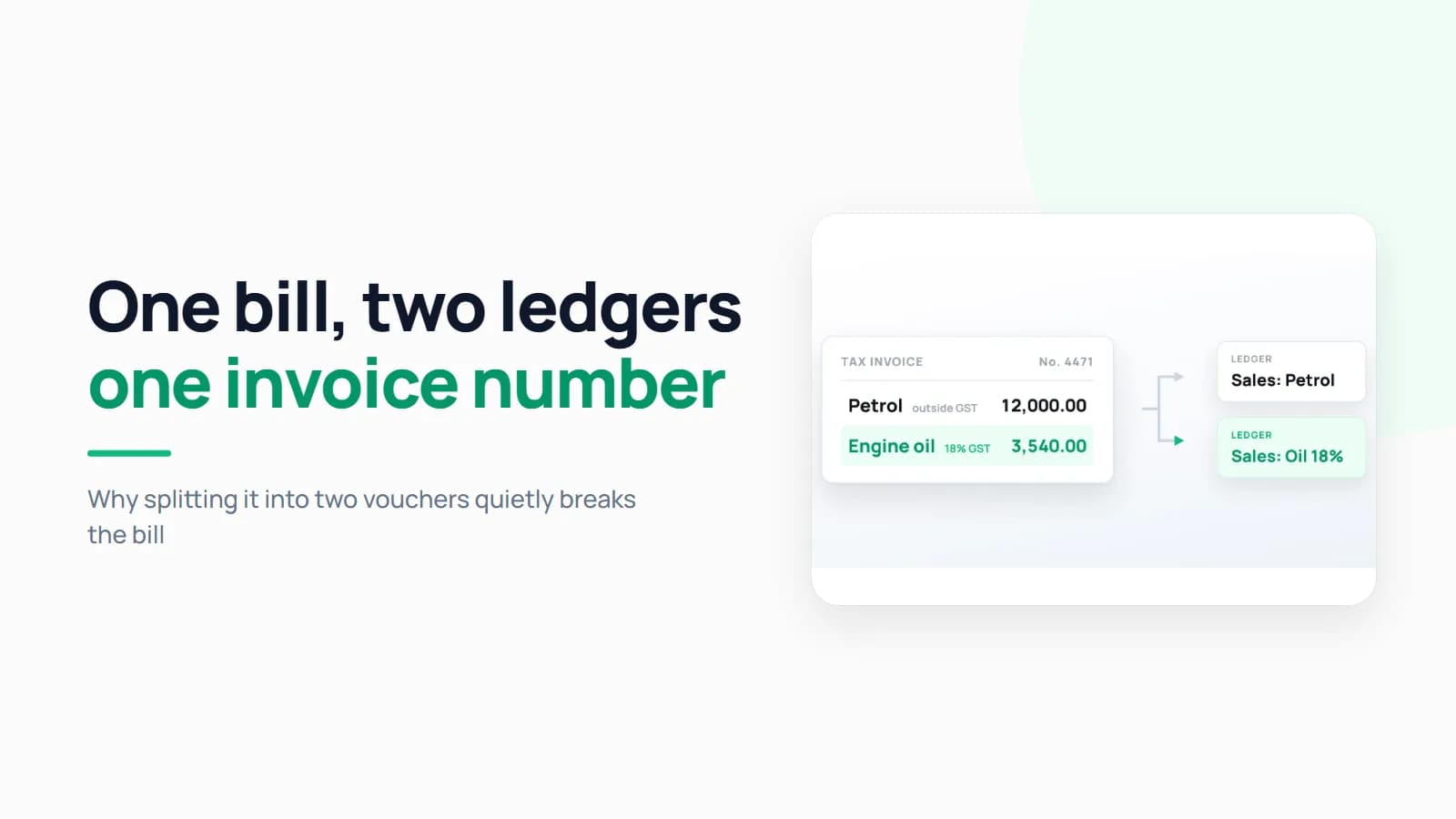
A petrol pump issues a counter bill with petrol on it and a litre of engine oil. Petrol sits outside GST and is taxed by the state; the oil is ordinary GST goods. Both are on one bill, under one bill number.
The same shape turns up far from a petrol pump. Goods at five per cent and goods at eighteen per cent on one sale. Exempt goods beside taxable ones. A bill that is part supply and part reimbursement.
The return wants the split. The books want one document. Most ways of resolving that quietly break one or the other.
Why one ledger will not do
Each part of the bill needs its own sales or purchase ledger, because the parts are different things for the return.
GSTR-1 reports a supply rate by rate. A bill carrying two rates has to appear as its parts, with each part's taxable value and its own tax. A single ledger holding the whole bill cannot produce that, because the information was merged before it was recorded.
The non-GST case is sharper still. Petrol is not a zero-rated supply or an exempt supply; it is outside the tax entirely, taxed under a different law. Putting it through the same ledger as the oil does not just lose a rate, it mixes two tax regimes in one figure.
So: as many ledgers as the bill has kinds of supply. The question is how to do that without the bill becoming several bills.
The two workarounds, and what each costs
Faced with this, most practices land on one of two answers, and both have a real cost.
Two vouchers. Enter the petrol as one sale and the oil as another. The ledgers are right and the return can be produced. What you now have is two documents in the books carrying one bill number. Any reconciliation that keys on the bill number sees a duplicate. A customer querying bill number 4471 is shown two entries. And the bill total appears nowhere as a single figure.
A journal. One entry, both ledgers, done. Except a journal is not an invoice: it carries no GST treatment, produces nothing for the return, and the bill drops out of the sales register entirely.
The first is wrong about identity. The second is wrong about tax. Neither is a mistake made out of carelessness; they are what remains when the entry method only allows one ledger per voucher.
Important
Two vouchers sharing an invoice number is the version that survives longest undetected, because nothing errors. It surfaces at a reconciliation, or when a customer asks why a bill appears twice.
What actually works
One voucher, several lines, each line with its own ledger, amount and tax.
In a sheet, that is written by repeating the invoice number on the next row and giving that row its own ledger, amount and tax. The rows stay rows while a person is looking at them, and are grouped into one voucher when the batch goes across.
It is the same convention a multi-item sheet already uses, and the one Tally's own imports expect, so there is no new idea here to learn. There is also no limit to how many parts a bill may have.
Two details matter when a bill is written this way.
Some fields belong to the bill, not to a line. One party, one GSTIN, one place of supply, one supplier's date, one original bill reference, one credit period, whatever the lines are. A continuation row can leave them blank and inherit them from the row that opened the bill. A cost centre is the opposite: it belongs to a line, because different parts of a bill can serve different cost centres.
A bill number alone is not an identity. Two suppliers can both issue a bill numbered 1001, and on the same day. What makes two rows the same bill is the number together with the party.
Pro tip
If you are setting a sheet up for a client who bills this way, decide the ledger names once and write them down. The split only stays consistent if the same part of the bill goes to the same ledger every month.
The checks worth doing on such a bill
Three, and they take a minute.
Does the sum of the parts equal the bill total? The parts have to add up to the document, to the paisa, and a rounding order applied part by part can leave a residual that the single-ledger version never had.
Does each part carry its own rate? A part with no rate cannot be reported rate-wise, which defeats the whole purpose of splitting it. What a mixed-rate bill does on import covers what is kept and what is lost.
Is the non-GST part actually outside GST, or is it exempt? These are not the same and they do not report the same way. A petrol line is outside the Act; an exempt supply is inside it and appears in the return as exempt. Getting this wrong puts a figure in the wrong box of a return the portal will or will not accept.
Conclusion
A bill is one document. If its parts are taxed differently, it needs several ledgers inside that one document, not several documents.
The method is unglamorous: repeat the number, give each row its ledger and its tax, let the bill-level fields fall through, and remember that the number alone does not identify a bill.
Turn bank statements into Tally vouchers on your own PC
Greenote reads 100+ Indian banks and posts clean vouchers straight into Tally, from your own PC. The statement is not uploaded, and nothing is typed by hand.
Free trial: 7 days or 5 statements, no card. Works with Tally Prime & ERP 9.